Anti-Inflammatory Meal Plan for Arthritis
7
Days
4
Meals / day
1900
Calories / day
Easy
Difficulty
For arthritis, food matters. Multiple trials show that anti-inflammatory eating reduces joint pain, morning stiffness, and inflammatory markers like CRP and IL-6 in both osteoarthritis and rheumatoid arthritis. This plan emphasizes the foods with the strongest joint-specific evidence: fatty fish, turmeric, ginger, cherries, leafy greens, and extra-virgin olive oil.
Arthritis is one of the few conditions where the dietary research is unambiguous: anti-inflammatory eating reduces joint pain, morning stiffness, and inflammatory markers in both rheumatoid arthritis and osteoarthritis. The Annals of Rheumatic Diseases has published multiple trials showing 20-40% reductions in patient-reported pain on Mediterranean-style diets within 8-12 weeks.
This plan is built around the four nutrients with the strongest joint-specific evidence: marine omega-3 (EPA and DHA from fatty fish), curcumin (from turmeric, with black pepper for absorption), gingerols (from fresh ginger), and tart cherry compounds (cyanidins). Salmon appears 4 times across the week, turmeric in 5 meals, ginger in 4. Walnuts, leafy greens, and berries fill in the polyphenol gaps.
This is an adjunct to medical care, never a replacement. Stay on your prescribed medications. Coordinate dietary changes with your rheumatologist, especially if you take blood thinners (omega-3 and turmeric have mild anticoagulant effects). The goal is to reduce flare frequency and severity, potentially allowing your doctor to reduce medication doses over time — never to skip them on your own.
Educational content. Not medical advice.
Information on this page is for educational purposes only. It is not a substitute for professional medical advice, diagnosis, or treatment. Consult your healthcare provider before changing your diet, especially if you have a medical condition, take medications, or are pregnant or breastfeeding. Read the full disclaimer.
What this plan looks like by the numbers
Macro distribution and calorie split per meal across an average day on the plan.
Macro breakdown
28%
40%
32%
Calories by meal
Who this is for
People with rheumatoid arthritis, osteoarthritis, or general joint pain who want to test how much diet can do alongside (not instead of) their medical care. Always coordinate with your rheumatologist.
What to expect
- Reduced morning stiffness within 2-3 weeks for most
- Less afternoon flare-ups from steady blood sugar
- Cumulative pain reduction over 6-8 weeks of consistent eating
- Better workout/movement tolerance from improved tissue inflammation
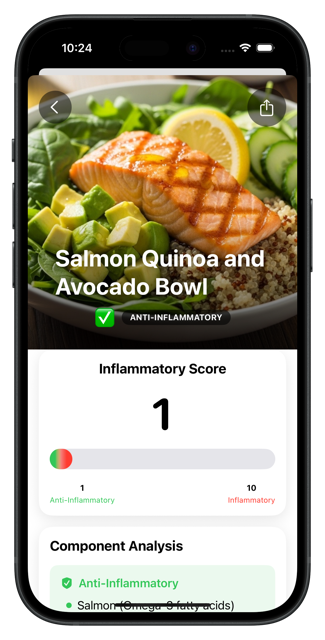
Build your own plan in the app
Scan any meal, see its inflammation score, and swap in better picks as you go.


The 7-day plan
Click any meal to see the full recipe with ingredients and instructions.
Day 1
Breakfast · Lunch · Dinner · Snack
Day 2
Breakfast · Lunch · Dinner · Snack
Day 3
Breakfast · Lunch · Dinner · Snack
Day 4
Breakfast · Lunch · Dinner · Snack
Day 5
Breakfast · Lunch · Dinner · Snack
Day 6
Breakfast · Lunch · Dinner · Snack
Why this plan works
Three mechanisms: omega-3 from salmon and walnuts directly competes with the omega-6 that builds inflammatory prostaglandins; curcumin in turmeric and gingerols in ginger are clinically validated COX-2 inhibitors (similar pathway as ibuprofen, no side effects); polyphenols from berries and leafy greens lower CRP via separate antioxidant pathways. Stack them and the effect compounds.
The science
A 2018 meta-analysis in Critical Reviews in Food Science found that Mediterranean-style anti-inflammatory diets significantly reduce DAS28 scores (the standard rheumatoid arthritis severity measure) and patient pain ratings in RA patients. Curcumin trials at 1000-1500mg/day (alongside food intake) show effects comparable to NSAIDs in some studies, with fewer side effects. Marine omega-3 at 2-3g EPA+DHA/day measurably reduces morning stiffness in RA patients within 12 weeks.
What happens week by week
A realistic timeline of changes you can expect if you stay consistent.
Initial relief
Morning stiffness shortens for many people by day 4-7. Joint warmth (a sign of active inflammation) may reduce. Energy improves from steady blood sugar.
Pain shifts
Baseline joint pain levels often drop 1-2 points on a 10-point scale by week 2. Flare frequency starts decreasing.
Medication conversation
After 4 weeks of consistency, talk to your rheumatologist about whether your medication dose can be adjusted. Don't change it on your own.
Lab markers
CRP and ESR (the two main blood inflammation markers) typically show measurable drops by week 12. This is the long-term win that makes the plan worth keeping.
5 mistakes to avoid
The shortcuts that quietly break the plan, plus how to fix them.
Eating turmeric without black pepper or fat
Fix: Curcumin absorption is ~5% on its own. Add black pepper (boosts ~2000%) and a fat (further enhances). Both are non-negotiable.
Stopping prescription medications
Fix: Diet is adjunct, never replacement. Coordinate with your rheumatologist before adjusting any meds.
Ignoring nightshade reactions
Fix: A subset of arthritis sufferers (~20%) flare on tomatoes, peppers, eggplant. Test cutting them for 3 weeks; reintroduce; see what happens.
Eating fish only once a week
Fix: Twice weekly minimum, three is better. The dose-response is real for joint outcomes.
Drinking through it
Fix: Alcohol drives inflammation and interacts with most arthritis medications. Limit to 1-2 drinks weekly while testing this plan.
How this compares to other diets
If you're choosing between approaches, here's the honest difference.
Diet
AIP (Autoimmune Protocol)
Similar to
Both target inflammatory autoimmune conditions.
Different
AIP is much stricter (no grains, legumes, nightshades, eggs, dairy, nuts, seeds for elimination phase). The arthritis plan is gentler and easier to maintain long-term.
Diet
Paleo
Similar to
Both eliminate processed foods and added sugar.
Different
Paleo cuts grains and legumes; the arthritis plan keeps them. Paleo's emphasis on red meat may not help joint pain.
Diet
Generic Mediterranean
Similar to
Same core principles.
Different
Arthritis plan emphasizes specific nutrients (turmeric, ginger, omega-3) more aggressively because of their joint-specific evidence.
Modifications
- •Add tart cherry juice (8oz daily) — strong evidence for reducing arthritis pain markers
- •Consider 500-1000mg curcumin supplement with piperine if you're not getting turmeric in 4+ meals/week
- •If nightshades (tomatoes, eggplant, peppers) trigger flares for you, swap them out where they appear
Pro tips
- →Fatty fish twice a week minimum. Three times if you can swing it.
- →Pair every turmeric meal with black pepper and a fat — it boosts curcumin absorption ~2000%
- →Avoid the inflammation triggers your rheumatologist flagged for you (often gluten, dairy, or nightshades for autoimmune RA)
Frequently asked
How fast will my joints feel better?
Most people report noticeable morning stiffness reduction by week 2-3. Significant pain reduction usually takes 6-8 weeks of consistent eating. Diet works alongside medical treatment, not instead of it.
Should I avoid nightshades?
There's no strong research evidence supporting universal nightshade avoidance, but a subset of arthritis sufferers report flares from tomatoes, peppers, and eggplant. Test it: cut them for 3 weeks, reintroduce, see if you flare.
Can diet replace my medication?
Almost certainly not. Diet is an adjunct that can reduce flares and potentially allow lower medication doses (with your doctor's input). Don't stop prescribed treatment without medical guidance.
Scan a food in 2 seconds. Know if it's healing or hurting you.
Point your camera at any meal, ingredient, or label. Get an instant inflammation score, the science behind it, and better alternatives. All free.