The Dietary Inflammatory Index, explained without the statistics degree
The Dietary Inflammatory Index (DII) is the most widely used research score for how inflammatory a diet is. It was published in 2014 by Nitin Shivappa, Susan Steck, James Hébert and colleagues at the University of South Carolina, in Public Health Nutrition, and has since been used in hundreds of studies.
It scores a whole diet, not a single food, on a scale that runs roughly from -10 (most anti-inflammatory) to +10 (most pro-inflammatory). Here is how the number is built, what it has been linked to, where it falls short, and what it means for what you put on your plate.
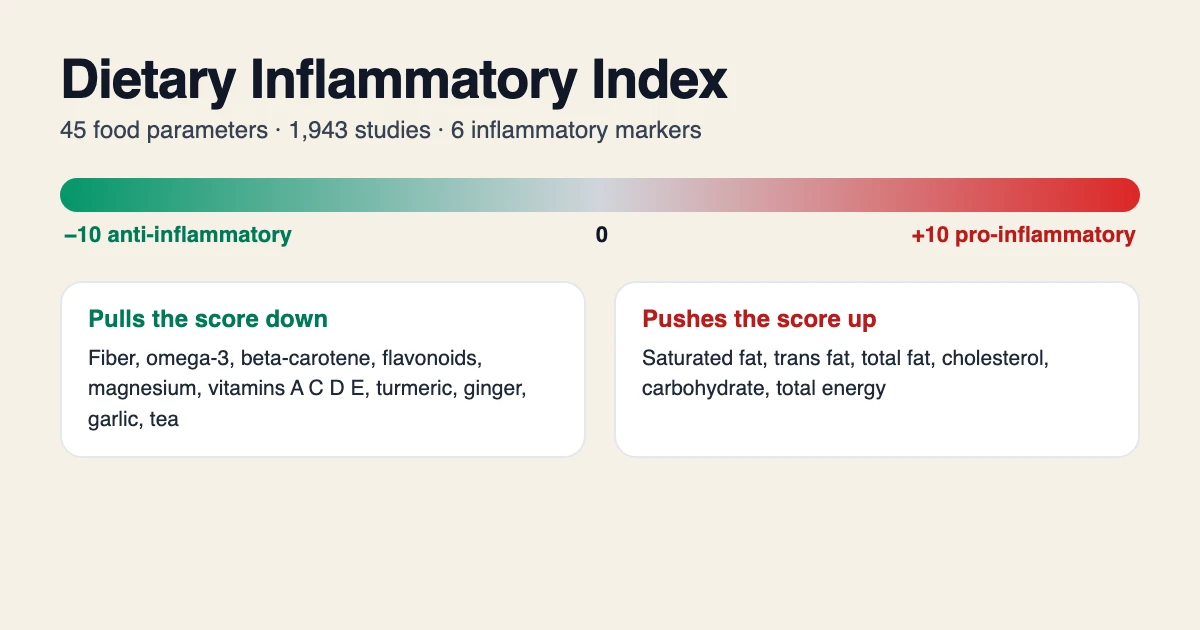
The DII at a glance
45
food parameters
1,943
studies reviewed
6
inflammatory markers
11
countries in the reference
How the score is calculated, in 8 steps
Steps 1 to 5 were done once by the researchers. Steps 6 to 8 happen for every person whose diet is scored.
| 1 | Collect the evidence | 1,943 articles published through 2010 linking 45 food parameters to six inflammatory markers: IL-1β, IL-4, IL-6, IL-10, TNF-α and C-reactive protein (CRP). |
| 2 | Score each article | +1 if the food parameter raised inflammation, 0 if no change, -1 if it lowered it. |
| 3 | Weight by study design | A human experiment counts more than a cell culture (table below). |
| 4 | Net effect per parameter | Pro-inflammatory fraction minus anti-inflammatory fraction. Parameters with a thin literature (under 236 weighted articles, the median) are scaled down. |
| 5 | Build a world reference | Intake data from 11 countries gives a global mean and standard deviation for each parameter. |
| 6 | Compare your intake | Your intake of each parameter becomes a z-score against that world average, then a centered percentile. |
| 7 | Multiply | Centered percentile × the parameter's inflammatory effect score. |
| 8 | Add it up | The sum across all available parameters is your DII. Negative is anti-inflammatory, positive is pro-inflammatory. |
How much each kind of study counts
| Study type | Design | Weight |
|---|---|---|
| Human | Experimental | 10 |
| Human | Prospective cohort | 8 |
| Human | Case-control | 7 |
| Human | Cross-sectional | 6 |
| Animal | Experimental | 5 |
| Cell culture | Experimental | 3 |
A worked example from the authors: saturated fat had 205 weighted articles. 47.3% found it pro-inflammatory and 4.4% anti-inflammatory, a net of 0.429. Because 205 is below the median of 236, it was scaled by 205/236, giving saturated fat an inflammatory effect score of 0.373.
What pushes the score up, and what pulls it down
The 45 parameters are mostly nutrients, plus a handful of spices and tea. The main ones on each side:
Anti-inflammatory (lower the DII)
- Fiber
- Omega-3 fatty acids
- Beta-carotene
- Flavonoids (several subclasses)
- Magnesium
- Vitamins A, C, D and E
- Zinc and selenium
- Turmeric, ginger, garlic, onion
- Green and black tea
Pro-inflammatory (raise the DII)
- Saturated fat
- Trans fat
- Cholesterol
- Total fat
- Carbohydrate
- Total energy (calories)
Notice that the DII thinks in nutrients, not foods. Salmon lowers it through omega-3 and vitamin D. A pastry raises it through saturated fat, refined carbohydrate and calories. Same idea as a food list, measured one level down.
What a high DII has been linked to
Early results presented by the index's authors. These are associations in observational cohorts, not proof that the diet caused the outcome.
| Study | Finding |
|---|---|
| SEASONS (about 500 adults, US) | Highest third of DII vs lowest: 47% to 61% higher odds of elevated CRP (above 3 mg/L). |
| Women's Health Initiative (2,600 women) | More pro-inflammatory diets linked to higher IL-6, TNF-α receptor 2 and hs-CRP (odds ratio 1.34 for elevated CRP, top vs bottom fifth). |
| Iowa Women's Health Study and WHI | Higher DII associated with more colorectal cancer in postmenopausal women. |
| NIH-AARP | Higher colorectal cancer risk in men; no association in women. |
| WHI, breast cancer | No association with invasive breast cancer overall. A signal for HER2-positive cancer and breast cancer mortality. |
Where the DII falls short
1.It depends on what people report eating
Food questionnaires and recalls carry measurement error, and most cohorts measured diet once, at baseline.
2.Not every study measures all 45 parameters
Many datasets lack spices, flavonoid subclasses or tea, so the score is often computed on 25 to 30 parameters. Two DII values from different studies are not always comparable.
3.It is relative to a world average
Your score says how your intake compares with an 11-country reference, not with an absolute healthy threshold.
4.It cannot score a single meal
The z-score step needs daily intake. A DII for one plate is not defined.
Free · iOS & Android
The DII scores a diet. Flammy scores the plate in front of you.
Photograph any food or meal and get a 1 to 10 inflammation score with the ingredients behind it. Free on iOS and Android.


DII vs a food-level inflammation score
People search for a "DII app" because they want the research number in their pocket. The honest answer is that the two tools answer different questions.
| Dietary Inflammatory Index | Flammy score | |
|---|---|---|
| Scores | A whole diet over time | One food or one meal |
| Scale | About -10 to +10 | 1 to 10 |
| Input | Detailed intake records, 45 parameters | A photo or a food name |
| Built for | Epidemiology research | Choosing what to eat |
| Answers | How inflammatory is this person's diet? | Is this plate a good choice, and what would make it better? |
They point the same way. The foods that score lowest on our scale (salmon, leafy greens, berries, turmeric, olive oil) are the ones rich in the DII's anti-inflammatory parameters, and the worst (processed meat, fried food, sugar) are heavy in the pro-inflammatory ones. Browse all 110 scored foods.
Seven ways to move your DII down
Each move targets parameters on the anti-inflammatory side or cuts ones on the other.
| Move | DII parameters it hits | In practice |
|---|---|---|
| Fatty fish twice a week | Omega-3 | Salmon or sardines |
| Legumes most days | Fiber, magnesium | Lentils, chickpeas, black beans |
| Colored vegetables at two meals | Beta-carotene, vitamin C, flavonoids | Carrots, bell peppers, kale, berries |
| Olive oil instead of butter | Lowers saturated fat | Extra virgin olive oil |
| Cook with the spice rack | Turmeric, ginger, garlic, onion | Curries, stir-fries, soups |
| Tea instead of soda | Flavonoids, fewer empty calories | Green tea, matcha |
| Cut processed and fried foods | Saturated and trans fat, excess energy | Deli meat, fries, pastries |
Dietary Inflammatory Index: common questions
What is the Dietary Inflammatory Index?
A research score, published by Shivappa and colleagues at the University of South Carolina in Public Health Nutrition in 2014, that rates the inflammatory potential of a whole diet. It combines intake of 45 food parameters, each weighted by how 1,943 studies found it affects six inflammatory markers. Scores run roughly from -10 (most anti-inflammatory) to +10 (most pro-inflammatory).
What is a good DII score?
Negative. Below zero means your intake leans anti-inflammatory compared with the 11-country world reference. In the Women's Health Initiative analysis, the healthiest third of women scored below about -2.4 and the least healthy third above about +0.5.
How do I calculate my DII?
You need a detailed record of what you eat (a food frequency questionnaire, food records or 24-hour recalls) converted into nutrient and food parameter intakes, then the published scoring algorithm. It is a research tool: there is no reliable way to calculate a true DII from a few meals or by hand.
Is there an app that calculates the Dietary Inflammatory Index?
Not one we can verify computes the published DII from everyday logging. The researchers mentioned an app in development back in 2014. Flammy is not a DII calculator: it scores individual foods and meals from 1 to 10 for inflammatory potential, which answers 'is this plate a good choice' rather than 'what is my diet's DII'.
Is the DII validated?
Higher DII scores have been associated with higher CRP and IL-6 in several cohorts, including SEASONS and the Women's Health Initiative. Associations are not proof of cause, and like every diet score it depends on self-reported intake, which carries measurement error.
Which foods lower the DII the most?
Foods rich in the parameters with negative scores: fiber, omega-3, flavonoids, beta-carotene and magnesium, plus turmeric, ginger, garlic and tea. In practice that means legumes, fatty fish, colored vegetables, berries, nuts, olive oil and spices, and less saturated fat, trans fat and excess calories.
Where to go from here
Background
What causes inflammation
Diet is one driver. The others matter too.
Compare diets
Anti-inflammatory vs Mediterranean
The 6 real differences.
Put it on a plate
Anti-inflammatory dinner ideas
A 7-night rotation and proteins ranked.
Start here
Anti-inflammatory diet for beginners
What the diet is, what it is not, and the first week.
Drinks
Anti-inflammatory tea
9 teas ranked by the evidence.
Scan a food in 2 seconds. Know if it's healing or hurting you.
Point your camera at any meal, ingredient, or label. Get an instant inflammation score, the science behind it, and better alternatives. All free.