Guide · Apps

Apps like Yuka: 7 alternatives, sorted by what Yuka can't do

Yuka is a good app. 99,000 App Store ratings at 4.8 stars, an independent scoring model, and free scanning. People who go looking for an alternative usually are not unhappy with it. They have hit one of its walls: no barcode on the plate in front of them, a score that says nothing about the thing their doctor told them to watch, or a US product that comes up empty.

So this list is sorted by wall. First the apps that do Yuka's job differently, then the ones that do the jobs Yuka was never built for. One of the seven is ours; it is marked, and every number here comes from the App Store listings so you can check.

Ratings and prices from the US App Store on September 11, 2026.

Yuka website: Make the right choices for your health, with a cereal box scored 8 out of 100

yuka.io on the review date. A box of cereal scored 8/100: the barcode is scanned, the label is decoded, the score is out of 100.

What Yuka does, and the five things it does not

Yuka scans a barcode, decodes the label and scores the product 0 to 100, with negatives (additives, sugar, salt) listed before positives (fiber, protein). It covers food and cosmetics, it takes no money from brands, and scanning is free. Those are the reasons it has 85 million users. Here is where it stops.

It needs a barcode

Restaurant plates, home cooking, deli counters, farmers market produce, coffee shop food: none of it scans. For a lot of people that is most of the week.

It scores additives and nutrition, not inflammation

Yuka's score is about 60% nutritional quality (calories, sugar, salt, fat, fiber, protein), 30% additives and 10% organic. Inflammation is a different question. Refined flour with no additives scores decently and still spikes blood sugar, one of the main drivers of chronic inflammation.

The useful extras are paid

Searching a product by name, offline mode and unlimited history need the premium contribution ($10 to $20 a year). Scanning stays free, which is fair, but the app you see in the ads is the paid one.

Food and cosmetics share one app

Handy if you scan shampoo. Noise if you only care about food. Several alternatives split the two or drop cosmetics entirely.

US coverage has gaps

Yuka is French and its database is deepest in Europe. It has grown fast in the US, but regional brands and store labels still come up missing more often than they do on Bobby Approved or Fig.

The 7 alternatives at a glance

AppInstead of Yuka whenScansPriceApp Store
Yuka(the baseline)BarcodeFree. Premium $10 to $20 a year4.8 (99K)
Bobby ApprovedFree, no score to interpretBarcodeFree, no in-app purchases4.9 (160K)
OliveYuka with more flags and an AI assistantBarcode, plus AI chatFree tier. Premium $7.99 to $14.99 a month4.8 (40K)
FigFor allergies and restrictionsBarcodeFree tier. Fig+ from $5.99 a month4.7 (16K)
Open Food FactsFree, open source, nonprofitBarcodeFree, no in-app purchases4.4 (140)
Trash PandaUltra-processed food, explained ingredient by ingredientBarcodeFree tier. Membership from $3.99 a month4.8 (3.7K)
Cal AIPhoto scanning for caloriesPhoto, plus barcodeFree trial, then $2.99 to $29.99 by plan4.8 (362K)
FlammyoursPhoto scanning for inflammationPhoto of any food or meal, or type its nameFree. Optional premium $34.99 a year4.3 (103)

The 7 apps like Yuka, one by one

Bobby Approved app screenshot

1. Free, no score to interpret

Bobby Approved

If Yuka's 0 to 100 score leaves you unsure what to do, Bobby Approved removes the ambiguity: every product is approved or it is not, based on Bobby Parrish's ingredient rules (no seed oils, no artificial sweeteners, no questionable additives). It is the most-rated food scanner on the App Store, 36 MB, and entirely free, with a store-by-store browse of approved products that Yuka does not have.

Stay with Yuka if: You want a graded score rather than pass/fail, or you disagree with Bobby's rules on seed oils.

Barcode · Free, no in-app purchases · 4.9 (160K)

Olive app screenshot

2. Yuka with more flags and an AI assistant

Olive

Olive markets itself as a 'premium Yuka alternative' and the description fits. Same barcode workflow for food and cosmetics, a longer list of flagged categories (seed oils, synthetic additives, endocrine disruptors, processed sugar, allergens), and an AI companion for follow-up questions. 40,000 ratings in under two years.

Stay with Yuka if: Olive's premium tiers are numerous and pricier than Yuka's yearly contribution. If free scanning is all you need, Yuka is cheaper.

Barcode, plus AI chat · Free tier. Premium $7.99 to $14.99 a month · 4.8 (40K)

Fig app screenshot

3. For allergies and restrictions

Fig

Yuka tells you whether a product is good in general. Fig tells you whether it is safe for you: set celiac, FODMAP, dairy, nuts, sesame or any of dozens of restrictions and every scan checks the label against your list. For allergy households it is not really an alternative to Yuka, it is the tool Yuka was never trying to be.

Stay with Yuka if: You have no restrictions and want quality scoring. Fig passes anything that avoids your triggers, healthy or not.

Barcode · Free tier. Fig+ from $5.99 a month · 4.7 (16K)

Open Food Facts app screenshot

4. Free, open source, nonprofit

Open Food Facts

The collaborative database behind a lot of scanner apps, as its own app. You get Nutri-Score, NOVA processing level and Eco-Score with no paywall and no company deciding the weighting. If Yuka's 'independence' pitch matters to you, this is the fully open version of it.

Stay with Yuka if: You want a polished consumer app. Open Food Facts looks like the database it is, and US coverage is thinner.

Barcode · Free, no in-app purchases · 4.4 (140)

Trash Panda app screenshot

5. Ultra-processed food, explained ingredient by ingredient

Trash Panda

Where Yuka gives you a number, Trash Panda gives you the reasoning: each flagged additive links to why and to sources, and the app is built around spotting ultra-processed food and finding cleaner swaps. The most transparent of the barcode scanners.

Stay with Yuka if: The small user base (3,700 ratings) means fewer products verified, and the depth sits behind a membership.

Barcode · Free tier. Membership from $3.99 a month · 4.8 (3.7K)

Cal AI app screenshot

6. Photo scanning for calories

Cal AI

The first thing Yuka cannot do: a plate. Cal AI photographs your meal and estimates calories and macros in seconds, which is why it collected 362,000 ratings in two years. If your reason for leaving Yuka is 'it does nothing at restaurants', Cal AI fixes that for calorie counting.

Stay with Yuka if: You care about ingredients and additives. Cal AI answers 'how many calories' and nothing else.

Photo, plus barcode · Free trial, then $2.99 to $29.99 by plan · 4.8 (362K)

Flammy app screenshot showing a cheeseburger with inflammatory score 8

7. Photo scanning for inflammation

Flammy(our app)

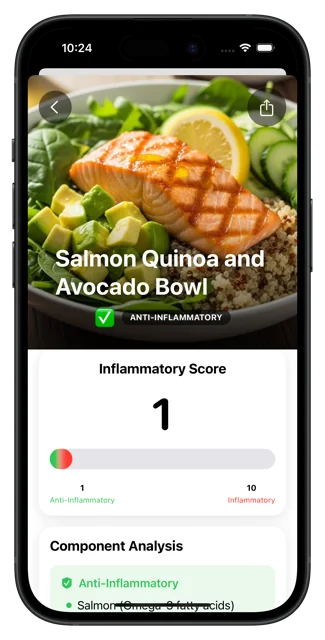
Our app, so read this one with that in mind. Flammy is the second thing Yuka cannot do: it scores inflammation. Photograph any food or meal, or type its name, and it returns an inflammation score from 1 (anti-inflammatory) to 10 (highly inflammatory), lists the ingredients as 'good' or 'watch out', and suggests a swap. No barcode needed, so it works on the restaurant plate and the home-cooked dinner. It comes with 110+ foods and 97 recipes on the same scale, and the scanner is free.

Stay with Yuka if: You want additive-level analysis of packaged products or cosmetics. Flammy does not read barcodes or count calories, and it has a fraction of Yuka's user base.

Photo of any food or meal, or type its name · Free. Optional premium $34.99 a year · 4.3 (103)

Free · iOS & Android

Yuka scores additives. Flammy scores inflammation.

Photograph any food or meal, no barcode needed, and get its inflammation score from 1 to 10 with the ingredients behind it. Free on iOS and Android.

Download Flammy on the App StoreGet Flammy on Google Play
Flammy app showing a food inflammation score

The gap none of the barcode apps fill

Six of the seven alternatives are still barcode scanners, and all of them, Yuka included, score the same family of things: additives, processing, nutrients on the label. That is useful at the supermarket. It says nothing about the two questions people on an anti-inflammatory diet actually ask: is this plate inflammatory, and what on it is the problem.

Take a bowl of white rice with grilled salmon. No barcode, no additives, nothing for Yuka to flag. Flammy scores the salmon a 1 and the white rice a 5, and tells you the swap (quinoa, a 3, or brown rice, a 4) that pulls the meal down. That is a different measurement, made on a different input, and it is the one this site exists for. If that is your question, the food library shows the same scores for 110 foods without installing anything.

Yuka alternatives: common questions

What is the best alternative to Yuka?

For the same job (scanning packaged food for additives), Bobby Approved is the strongest free alternative and Olive the closest paid one. For the jobs Yuka cannot do, Fig covers allergies, Cal AI scans a plate for calories, and Flammy scans a plate or a typed food for its inflammation score.

Is Yuka free?

Scanning is free. The premium version, which Yuka calls a contribution, costs $10, $15 or $20 a year in the US App Store and unlocks search by name, offline mode and unlimited history.

Is there a free app like Yuka?

Bobby Approved and Open Food Facts are free with no in-app purchases. Flammy's scanner is free with an optional premium. Yuka itself is free for scanning, so the reason to switch is usually a feature (photo scanning, allergy checks, inflammation scoring) rather than price.

Does Yuka work without a barcode?

No. Yuka identifies products by barcode. Premium adds search by name for packaged products, but there is no way to scan a restaurant meal or a home-cooked plate. Cal AI and Flammy work from a photo instead.

Does Yuka tell you if a food is inflammatory?

No. Yuka's score combines nutritional quality, additives and organic status. It does not assess inflammatory impact, and a product can score well on Yuka while being highly inflammatory (refined carbohydrates with no additives, for example). Flammy is built around that measurement: a 1 to 10 inflammation score for any food or meal.

Is Yuka accurate?

For packaged products in its database, yes, within the limits of its method: the score is a formula over the label, and the label is only as current as the last database update. The larger accuracy question is scope. It measures additives and nutrients, so it is not 'inaccurate' about inflammation or allergens, it simply does not measure them.

Free · iOS & Android

Scan a food in 2 seconds. Know if it's healing or hurting you.

Point your camera at any meal, ingredient, or label. Get an instant inflammation score, the science behind it, and better alternatives. All free.

Camera scanAI-powered1–10 scoreBetter swaps
Download Flammy on the App StoreGet Flammy on Google Play