Is Yuka accurate? Yes, at a narrower job than people think
Short answer: Yuka's score is an honest, published formula applied to the label, and it does that job well. The problem is not accuracy. It is that people read a Yuka score as "is this good for me", and the formula answers a smaller question: how does this label rate on nutrients per 100 g, additives and organic status.
Below is the formula, a verdict on each part, the five cases where the number misleads, and the one thing it never measures. We make a competing app (Flammy, which scores inflammation), so every claim about Yuka here is taken from Yuka's own help pages and App Store listing.
Sources checked on October 7, 2026. Yuka: 4.8 stars from 100,000+ ratings on the US App Store.
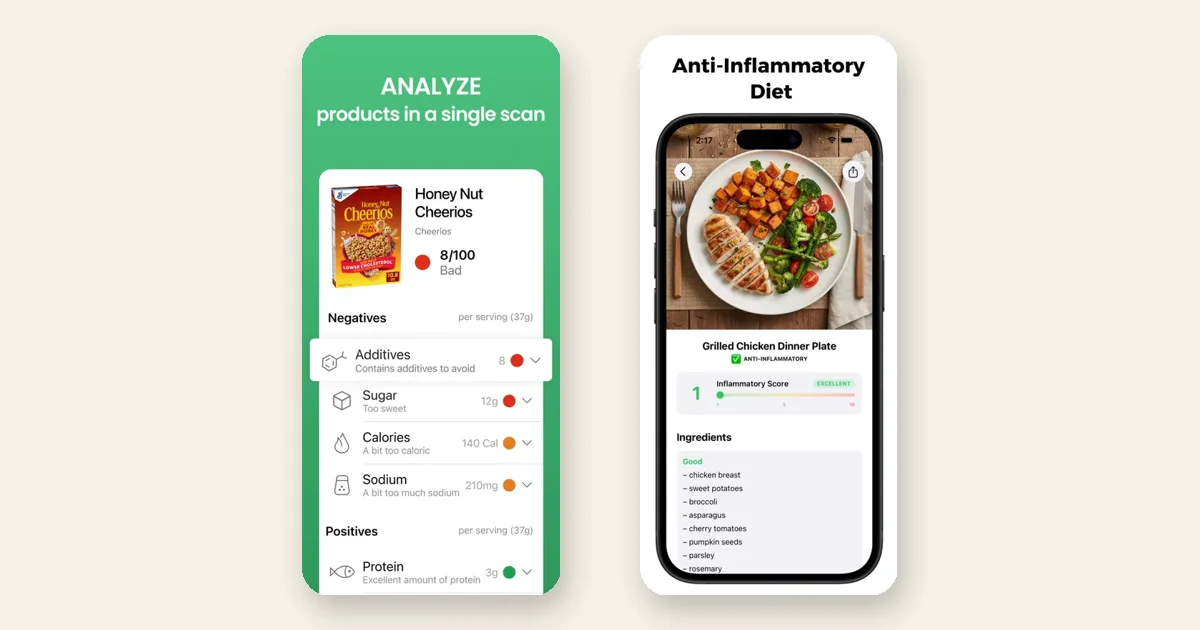
Left: Yuka scores a barcode out of 100. Right: Flammy scores a photo for inflammation, 1 to 10.
How the Yuka score is calculated
Three parts, fixed weights. This is all of it:
| Part | Weight | What it is based on |
|---|---|---|
| Nutritional quality | 60% | Nutri-Score: sugar, sodium, saturated fat, calories, protein, fiber, fruit and vegetable content, per 100 g |
| Additives | 30% | Yuka's own risk rating for each additive: green (risk-free), yellow (limited), orange (moderate), red (high risk) |
| Organic | 10% | Bonus for an official organic label |
One override sits on top: a single high-risk additive caps the product at 49 out of 100, however good the rest of the label is. That rule explains most of the "why is this healthy thing orange?" complaints you will find about the app.
Accurate or not: six questions, six verdicts
| Question | Verdict | Why |
|---|---|---|
| Does the score match the label? | Yes | The math is a published formula applied to the ingredient list and nutrition panel. Same label, same score. |
| Is the nutrition part science-based? | Yes | It is Nutri-Score, the label designed by French public health researchers and adopted by seven European countries. |
| Are red additives proven dangerous? | Not settled | Many red-rated additives are legal in the US and EU. Yuka rates them on its own reading of the research, which is stricter than the regulators'. |
| Does it reflect a normal serving? | No | Nutri-Score works per 100 g. Olive oil and a soda are judged on the same weight, not on how much you actually eat. |
| Does it tell you if a food is inflammatory? | No | Nothing in the formula measures inflammatory impact. A product can score green and still be the kind of food an anti-inflammatory diet cuts. |
| Is the product data current? | Mostly | The database holds 4 million food products. Reformulated products can carry an old label until someone rescans them. |
Five places a Yuka score misleads you
None of these are bugs. They follow directly from the formula, which is why they show up on every product, not just a few.
1.One red additive caps the product at 49
Yuka's own help page says it: if a high-risk additive is present, the maximum score is 49/100, and that criterion can then weigh more than 30%. A yogurt with excellent nutrition and one flagged additive lands in the same orange band as a mediocre snack with none. The cap is a deliberate editorial choice, and a defensible one, but it means a 45 can mean two very different things.
2.Per 100 g penalizes foods you eat by the spoonful
Nutri-Score rates every product on 100 g. Nobody eats 100 g of olive oil, so fats get judged on an amount that never reaches a plate. The updated Nutri-Score algorithm (2023) moved olive oils from C up to B. The general problem stays for nuts, cheese and dressings: the score reads the label, not the portion.
3.Organic earns points regardless of what it is
The 10% organic bonus applies to organic sugar and organic cookies the same way it applies to organic lentils. Organic farming limits synthetic pesticides. It does not change how a food affects blood sugar or inflammation.
4.Fresh food never gets a score
Yuka identifies products by barcode. Produce, fish from the counter, restaurant plates and home cooking do not exist in it. On an anti-inflammatory diet those are most of what you eat, so the app sees the smallest and least healthy slice of your week.
5.Clean label is not the same as low inflammation
White bread with no additives, organic flour and moderate salt can score respectably. Refined flour is still one of the foods most anti-inflammatory guidelines tell you to cut, because it raises blood sugar fast. Yuka is accurate about what it measures. It just does not measure that.

Free · iOS & Android
Yuka reads the label. Flammy reads the plate.
Photograph any food or meal, no barcode needed, and get its inflammation score from 1 to 10 with the ingredients behind it.


The nitrite lawsuit, and what it says about the additive ratings
The strongest test of Yuka's additive ratings happened in court. Yuka flagged added nitrites in cured meats as high risk, linked them to cancer, and promoted a petition with Foodwatch and the French League Against Cancer to ban them. The French cured meat federation (FICT) sued for disparagement.
In 2021 Yuka lost the first rulings and was ordered to pay damages. Later rulings in Aix-en-Provence and Brive went Yuka's way, and on June 7, 2023 the Paris Court of Appeal ruled that Yuka had the right to inform consumers about nitrites and ordered the federation to pay it 60,000 euros.
Read that for what it is. A court found the warning was legitimate information backed by research, not that every red dot in the app is proven harmful. Yuka's ratings lean cautious on purpose. If you want caution, that is a feature. If you want the regulatory line, the app is stricter than the FDA.
What Yuka never measures: inflammation
If you opened Yuka because a doctor told you to eat less inflammatory food, this is the gap. The left column is how the formula treats each food. The right column is its score on Flammy's 1 to 10 inflammation scale (1 is strongly anti-inflammatory, 10 is highly inflammatory).
| Food | How Yuka handles it | Inflammation score |
|---|---|---|
| Extra virgin olive oil | Judged per 100 g on fat. Rated B under the updated Nutri-Score | 1/10 |
| White bread, no additives | No additive penalty. Middle of the scale on nutrition | 7/10 |
| White rice | Plain rice has no additives to flag | 5/10 |
| Butter | Penalized for saturated fat per 100 g | 6/10 |
| Fresh salmon fillet | No barcode at the fish counter, no score | 1/10 |
| Blueberries, loose | No barcode, no score | 1/10 |
The two tools disagree most on fats and on refined carbs, and they cannot disagree at all on fresh food, because Yuka has no score for it. Use Yuka in the cereal aisle. Use an inflammation score for the meal. The food library has the scores for 110 foods without installing anything.
Should you trust Yuka?
Trust it for comparing two packaged products on the same shelf. That is exactly what the formula was built for, and it is consistent and independent of brands.
Do not trust it as a verdict on your diet. It ignores portion size, rewards organic sugar, has no opinion on fresh food and does not measure inflammation, blood sugar response or allergens. If any of those is the reason you are scanning, you need a second tool, and our list of Yuka alternatives sorts them by which of those gaps they fill.
Yuka accuracy: common questions
Is the Yuka app accurate?
It is accurate at what it measures: a fixed formula over the label, 60% Nutri-Score nutrition, 30% additives and 10% organic. It is not a measure of overall healthiness for your diet, it ignores serving size, and it says nothing about inflammation, allergens or fresh food.
Is Yuka reliable for additives?
Its additive ratings are consistent and sourced, but stricter than US and EU regulators. Many additives Yuka rates red are legally approved. Treat a red dot as 'Yuka's researchers would avoid this', not as 'this is unsafe'.
Why does Yuka give olive oil a bad score?
Because Nutri-Score rates every product per 100 g, and 100 g of any oil is mostly fat and calories. The 2023 algorithm update moved olive oil to B. On an inflammation scale it is one of the best foods there is: Flammy scores extra virgin olive oil a 1 out of 10.
Did Yuka lose a lawsuit?
It lost the first round. In 2021 French courts ordered Yuka to pay damages to the cured meat federation over its nitrite warnings. On June 7, 2023 the Paris Court of Appeal reversed that and ruled for Yuka, ordering the federation to pay damages instead. The nitrite warning is still in the app.
Does Yuka make money from brands?
No. The app runs no ads and says no brand can influence a score. Revenue comes from users who pay for the optional premium version, which is how it stays independent of brands.
What is a good score on Yuka?
Higher is better on a 0 to 100 scale, and the app labels results from bad to excellent. The number is most useful for comparing two similar products on the same shelf, which is the job it was designed for.
Where to go from here
Alternatives
Apps like Yuka
7 alternatives, sorted by what Yuka cannot do.
Accuracy
Is Cal AI accurate?
What an NIH test of photo calorie apps found.
The full list
Best food scanner apps
8 apps compared by what they scan and what they score.
Cut first
Inflammatory foods to avoid
The foods that score worst, with the swaps.
Scan a food in 2 seconds. Know if it's healing or hurting you.
Point your camera at any meal, ingredient, or label. Get an instant inflammation score, the science behind it, and better alternatives. All free.