Guide · Apps

The best food scanner apps, compared by what they actually scan

"Food scanner app" covers three different products. Barcode scanners like Yuka read a packaged product's label and score the ingredients. Photo scanners like Cal AI look at the plate and estimate what is on it. And a few score a specific health dimension, such as allergens or inflammation, instead of general "healthiness". Pick the wrong category and the app is useless for your question.

Below are the 8 worth installing, with what each one scans, what it scores, the real price from the App Store, and the case where it beats the others. One of them is ours. It is marked, and the comparison is written so you can check every claim in the listings.

Ratings and prices from the US App Store on September 11, 2026. Android availability noted where it differs.

Four Flammy screens: a chicken plate scored 1, a cheeseburger scored 8, spinach details, and the recipe list

Photo scanning in practice: a grilled chicken plate scores 1, a cheeseburger and fries scores 8. Neither has a barcode.

The first decision: barcode or photo

A barcode scanner is precise and limited. Precise because the product is identified exactly and the ingredient list is the real one. Limited because most of what people eat has no barcode: a restaurant meal, a home-cooked dinner, an apple, a coffee shop pastry. Six of the eight apps below are barcode scanners, and all six go blank the moment you sit down at a table.

A photo scanner is the opposite. It works on any plate, but it is estimating: it recognizes chicken, rice and broccoli, not the brand of oil they were cooked in. Two apps here work from photos. Cal AI turns the photo into calories. Flammy turns it into an inflammation score.

The second decision is what you want scored. "Healthy" is not a measurement. Yuka measures nutritional quality and additives. Fig measures whether it matches your restrictions. Cal AI measures calories. Flammy measures inflammatory impact. Choose the measurement first and the app picks itself.

The 8 apps side by side

AppScansScoresPriceApp Store
YukaBarcode0 to 100 health score: nutrition, additives, organicFree. Premium is a yearly contribution of $10 to $204.8 (99K)
Bobby ApprovedBarcodeApproved or not, by one set of ingredient rulesFree, no in-app purchases4.9 (160K)
OliveBarcode, plus AI chatFlags seed oils, additives, allergens, endocrine disruptorsFree tier. Premium $7.99 to $14.99 a month or $19 to $70 a year4.8 (40K)
FigBarcodeSafe or not for your specific restrictionsFree tier. Fig+ $5.99 to $7.49 a month or $35 to $70 a year4.7 (16K)
Open Food FactsBarcodeNutri-Score, NOVA processing level, Eco-ScoreFree, nonprofit, no in-app purchases4.4 (140)
Trash PandaBarcodeIngredient-by-ingredient breakdown, processing levelFree tier. Membership $3.99 to $7.99 a month or $30 to $50 a year4.8 (3.7K)
Cal AIPhoto of the plate, plus barcodeCalories, protein, carbs, fatFree trial, then $2.99 to $29.99 depending on plan4.8 (362K)
FlammyoursPhoto of any food or meal, or type its nameInflammation score 1 to 10, ingredients marked good or watch outFree. Optional premium $34.99 a year4.3 (103)

Each app, and the case where it wins

Yuka app screenshot

1. Best for packaged food and cosmetics at the supermarket

Yuka

The one everyone has heard of, and for packaged products it earns it. Scan a barcode and you get a score out of 100 built from nutritional quality (about 60%), additives (30%) and whether it is organic (10%), with the negatives listed first. The database is huge, the app is independent (no brand pays to be listed) and the free version covers scanning.

Where it stops: Barcode only. A restaurant plate, a home-cooked meal or loose produce has no barcode, so Yuka has nothing to say about most of what you actually eat. It also has no concept of inflammation: a product can score well on additives and still be a blood sugar spike in a box. Search by name, offline mode and unlimited history are paid.

Barcode · Free. Premium is a yearly contribution of $10 to $20 · 4.8 (99K)

Bobby Approved app screenshot

2. Best for a strict yes/no on ingredients

Bobby Approved

Made by Bobby Parrish of FlavCity. Every product is either approved or not, based on his ingredient standards: no seed oils, no artificial sweeteners, no questionable additives. There is no score to interpret, which is why it has 160,000 ratings and a 4.9 average. Completely free, 36 MB, and it lets you browse approved products by store.

Where it stops: One person's rules, applied as pass/fail. If you disagree with Bobby on seed oils or sweeteners there is no nuance to fall back on. Barcode only, packaged food only, and no nutrition or inflammation dimension: a bag of approved tortilla chips is still chips.

Barcode · Free, no in-app purchases · 4.9 (160K)

Olive app screenshot

3. Best for yuka-style scanning with an ai assistant

Olive

Launched in 2025 and openly marketed as a 'premium Yuka alternative'. It scans food and cosmetics, flags a longer list of ingredient categories than Yuka (seed oils, synthetic additives, endocrine disruptors, processed sugar) and adds an AI health companion you can ask questions.

Where it stops: The price list on the App Store has a dozen different premium tiers, which usually means the paywall changes depending on the onboarding path. Rated 17+. Still barcode-first, so the same blind spot as Yuka on unpackaged food.

Barcode, plus AI chat · Free tier. Premium $7.99 to $14.99 a month or $19 to $70 a year · 4.8 (40K)

Fig app screenshot

4. Best for allergies and strict dietary restrictions

Fig

Fig does one thing the others do not: you tell it your restrictions (celiac, FODMAP, dairy, tree nuts, dozens more) and every scan answers 'can I eat this' for you specifically. For anyone managing an allergy or an elimination diet it is the right tool and the 1M+ members claim is believable.

Where it stops: It is a restriction checker, not a quality scorer. A product with none of your triggers gets a pass whether it is healthy or not. The free tier is limited and rated 17+.

Barcode · Free tier. Fig+ $5.99 to $7.49 a month or $35 to $70 a year · 4.7 (16K)

Open Food Facts app screenshot

5. Best for free, open data with nutri-score and nova

Open Food Facts

The database most of the other apps quietly rely on, as its own app. Collaborative since 2012, run by a nonprofit, and it shows the three standard European scores: Nutri-Score (A to E), NOVA (1 to 4 for processing) and Eco-Score. No paywall, ever.

Where it stops: It looks like a database app because it is one. Coverage of US products is patchier than European ones, and the app expects you to help fill in missing items. No inflammation angle and no photo recognition.

Barcode · Free, nonprofit, no in-app purchases · 4.4 (140)

Trash Panda app screenshot

6. Best for ultra-processed food and hidden additives

Trash Panda

The most transparent of the bunch about why an ingredient is flagged: every additive links to the reasoning and the sources. Its focus is ultra-processed food, which overlaps a lot with what drives inflammation, and it suggests cleaner swaps.

Where it stops: Small user base (3,700 ratings), and the useful parts sit behind a membership. Packaged food only.

Barcode · Free tier. Membership $3.99 to $7.99 a month or $30 to $50 a year · 4.8 (3.7K)

Cal AI app screenshot

7. Best for calories and macros from a photo

Cal AI

The app that made photo scanning mainstream. Point the camera at a plate and it estimates calories and macros in a few seconds. 362,000 ratings in two years says the photo approach works for people who hated logging food by hand.

Where it stops: It answers one question: how many calories. Nothing about ingredients, additives or inflammation. Photo estimates are approximate by nature, the 310 MB download is the heaviest here, and the free trial converts to a subscription fast.

Photo of the plate, plus barcode · Free trial, then $2.99 to $29.99 depending on plan · 4.8 (362K)

Flammy app screenshot showing a grilled chicken plate with inflammatory score 1

8. Best for knowing whether a food is inflammatory

Flammy(our app)

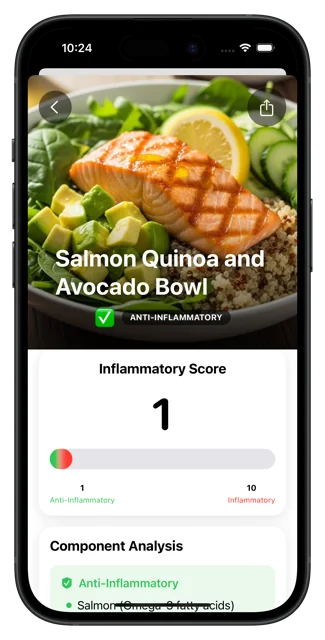
Our app, so weigh this paragraph accordingly. Flammy is the only scanner in this list built around inflammation: photograph a plate, a snack or a menu item, or type a food, and it returns a score from 1 (anti-inflammatory) to 10 (highly inflammatory), splits the ingredients into 'good' and 'watch out', and suggests swaps. Because it works from a photo, it covers restaurant food, home cooking and loose produce, not just barcodes. It also ships a library of 110+ foods and 97 recipes, all on the same scale.

Where it stops: It does not read barcodes or count calories, and the user base is small (103 ratings). If you want additive-by-additive analysis of packaged products, Yuka or Trash Panda go deeper. If you want to know what a cheeseburger, a smoothie or a bowl of oats does to inflammation, this is the one that answers.

Photo of any food or meal, or type its name · Free. Optional premium $34.99 a year · 4.3 (103)

Free · iOS & Android

The scanner that scores inflammation, not just additives

Photograph any food or meal and get an inflammation score from 1 to 10, the ingredients behind it, and a better swap. Free on iOS and Android.

Download Flammy on the App StoreGet Flammy on Google Play
Flammy app showing a food inflammation score

How to choose in 30 seconds

You mostly buy packaged food and want additives flaggedYuka, or Trash Panda for more detail
You want a simple approved / not approvedBobby Approved
You have an allergy or a strict elimination dietFig
You want the open, nonprofit option with Nutri-ScoreOpen Food Facts
You count calories and hate loggingCal AI
You want to know if a food or meal is inflammatoryFlammy
You eat out or cook at home more than you scan packagesA photo app: Cal AI for calories, Flammy for inflammation

Installing two is normal. A barcode app for the supermarket and a photo app for everything else covers the whole day; between them they are a few hundred megabytes and, in the free tiers, zero dollars.

Food scanner apps: common questions

What is the best food scanner app?

It depends on the question you want answered. For packaged products and additives, Yuka. For a strict yes/no on ingredients, Bobby Approved (free). For allergies, Fig. For calories from a photo, Cal AI. For whether a food is inflammatory, Flammy, which scores any food or meal from 1 to 10. No single app does all of it.

Which food scanner apps are completely free?

Bobby Approved and Open Food Facts have no in-app purchases at all. Yuka, Flammy and Trash Panda are free to use for scanning with an optional premium. Olive, Fig and Cal AI have free tiers or trials that push you to a subscription for regular use.

Is there a food scanner app that works without a barcode?

Yes. Cal AI and Flammy recognize food from a photo, so they work on restaurant plates, home-cooked meals and loose produce. Cal AI returns calories and macros; Flammy returns an inflammation score with the ingredients that drive it. Yuka, Bobby Approved, Fig, Olive, Open Food Facts and Trash Panda need a barcode.

Is there an app that tells you if food is inflammatory?

Flammy does exactly that: scan or search a food and it gives an inflammation score from 1 to 10 with the reasons. The barcode scanners (Yuka, Bobby Approved, Trash Panda) flag additives and processing, which overlaps with inflammation but is not the same measurement; a product can be additive-free and still highly inflammatory.

How accurate are food scanner apps?

Barcode apps are as accurate as their database entry for that product; errors come from outdated or user-submitted data. Photo apps estimate, and the estimate is better for a clear plate of recognizable food than for a mixed casserole. Treat any score as a strong hint, not a lab result, and check the ingredient list the app shows you.

Do food scanner apps work in the US?

All eight here have US databases. Yuka, Bobby Approved, Fig, Trash Panda and Cal AI are US-first. Open Food Facts started in Europe and its US coverage is thinner. Photo-based apps like Cal AI and Flammy do not depend on a product database, so they work anywhere.

Free · iOS & Android

Scan a food in 2 seconds. Know if it's healing or hurting you.

Point your camera at any meal, ingredient, or label. Get an instant inflammation score, the science behind it, and better alternatives. All free.

Camera scanAI-powered1–10 scoreBetter swaps
Download Flammy on the App StoreGet Flammy on Google Play