Is Cal AI accurate? It missed a third of the calories
Researchers at the NIH's National Institute of Diabetes and Digestive and Kidney Diseases cooked 102 meals in a metabolic kitchen, weighed every ingredient to a tenth of a gram, and photographed them with four calorie apps. Cal AI was one of them. It had the largest average miss of the four. The results were presented at NUTRITION 2026 in July.
That does not make the app useless. It makes it a rough estimate that runs low, and knowing by how much is what lets you use it. Here are the numbers, why photo counting misses, when the error matters, and how to shrink it.
Cal AI: 4.8 stars from 368,000+ ratings on the US App Store, checked October 7, 2026. We make Flammy, a photo scanner that scores inflammation, not calories.
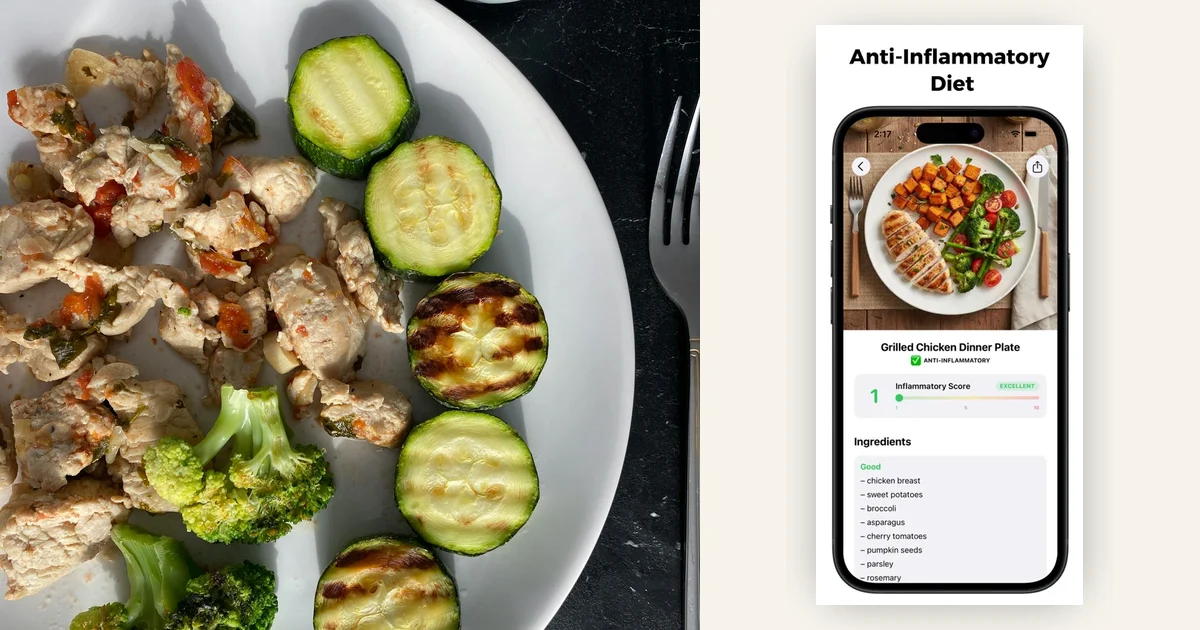
Same kind of photo, different question. Cal AI estimates calories from it. Flammy scores the food for inflammation.
The results: calories missed per meal
Average underestimate across the 102 meals, with the 95% confidence range. On average, every app reported fewer calories than the plate held.
| What was measured | Finding |
|---|---|
| Total energy | Underestimated by about 33% across the four apps |
| Fat | Underestimated by about 30 g per meal |
| Carbohydrates | The most consistent macro. Cal AI and Lose It! missed about 14 g |
| Keto meals | Larger misses in a follow-up of 200+ more meals |
| Ground truth | Ingredients weighed to 0.1 g in an NIH metabolic kitchen |
Put the 33% in daily terms. If an app misses a third, a day it logs at 1,500 calories was really about 2,250. That is the difference between a deficit and maintenance for most adults.
Why photo calorie counting runs low
Fat is invisible
A tablespoon of olive oil is about 120 calories and looks like nothing in a photo. Butter melted into rice, oil soaked into roasted vegetables, cream in a sauce: the camera sees the food, not what it was cooked in. The NIH test found fat underestimated by about 30 grams per meal, which alone is roughly 270 calories.
A photo has no depth
From above, a shallow bowl and a deep one look the same. Portion size is the single biggest variable in calories, and a 2D image has to guess it from the plate and nearby objects.
Mixed dishes hide their ingredients
A burrito, a casserole or a curry is a closed box. The app recognizes the dish and assigns a typical recipe, which may have half the cheese or twice the rice of yours.
High-fat, low-carb meals miss the most
In a follow-up of more than 200 additional meals, the researchers found the apps did worse on ketogenic meals, consistent with fat being the hardest thing to see. If you eat keto or lots of nuts, cheese and oil, expect a bigger gap.
Is it accurate enough for your goal?
Accuracy only matters relative to what you are using the number for.
| Your goal | Cal AI alone? | Why |
|---|---|---|
| Rough awareness of what you eat | Good enough | The ranking of meals (big lunch vs light lunch) survives the error even if the numbers do not. |
| Weight loss with a tight deficit | Not on its own | A 300 kcal miss per meal can erase a 500 kcal daily deficit by lunch. |
| Tracking carbs | Closer | Carbs were the most consistent macro in the study. Cal AI missed about 14 g per meal. |
| Tracking fat or keto macros | No | Fat was the biggest miss, about 30 g per meal, and worse on keto meals. |
| Medical diets (diabetes insulin dosing, kidney disease) | No | Use weighed portions and a dietitian's numbers. Cal AI's own listing says it does not offer medical advice. |
7 ways to get closer numbers out of Cal AI
The errors are predictable, so most of them can be corrected by hand. In order of how much they help:
- Log cooking fat separately. Add "1 tbsp olive oil" or "1 tbsp butter" by hand whenever the food was cooked in it.
- Correct the portion after the scan. If the app says 1 cup of rice and you know you served 2, change it.
- Shoot from a 45 degree angle, not straight down, so the depth of the bowl is visible.
- Put a fork or your hand in the frame for scale.
- Split mixed dishes into parts when you can ("burrito: tortilla, rice, beans, cheese, guac").
- For packaged food, scan the barcode instead of taking a photo. The label beats the estimate.
- Sanity check for a week: weigh one meal a day and compare. If the app runs low for you, you now know by how much.
A photo can't weigh your oil. It can tell you what's in the meal.
Flammy scores any food or meal from 1 to 10 for inflammation and names the ingredients behind the score. No grams to guess. Free on iOS and Android.


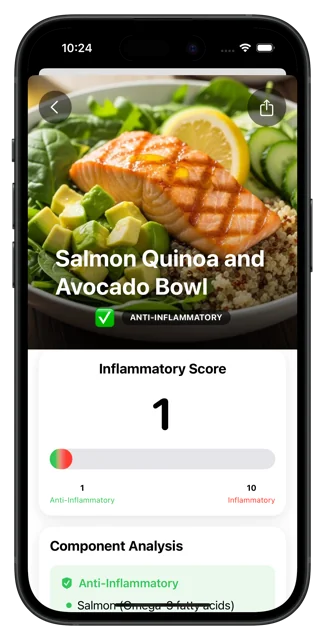
Calories are one question. Not the only one.
The error in photo counting is mostly about quantity: how many grams, how much oil. Some questions do not depend on quantity. Whether a meal is built on salmon and vegetables or on fries and white bread is visible in the photo, and the answer does not change if the portion is 20% bigger than the app thinks.
That is the question Flammy answers. It reads the same photo, identifies the foods, and scores the meal for inflammation (salmon is a 1, white bread a 7, French fries an 8), with a swap for the worst item. It does not count calories, so it is not a Cal AI replacement if calories are your goal. It is the other half of the plate. If you want to see the scale first, the 110-food library and the food vs food comparisons use the same scores.
Cal AI accuracy: common questions
Is Cal AI accurate?
Not very, for calories. In a 2026 NIH test of 102 weighed meals, Cal AI underestimated calories by 345 per meal on average, the largest miss of the four apps tested, and the apps together missed about a third of the energy in each meal. It is better at carbs than fat.
Does Cal AI overestimate or underestimate calories?
In the NIH test it underestimated, consistently. All four apps reported fewer calories than the meals contained, mostly because they missed fat. Individual meals can go either way, but the average error ran low.
Is Cal AI more accurate than MyFitnessPal?
In that test, no. MyFitnessPal missed 327 kcal per meal and Cal AI 345, with overlapping confidence ranges, so treat them as roughly equal. Appediet was the least inaccurate at 252.
Is Cal AI free?
No for regular use. The App Store listing states that food scanning analysis results require a subscription. There is a trial.
How can I make Cal AI more accurate?
Add cooking oil and butter by hand, correct the portion size after each scan, photograph at an angle with something for scale, and use the barcode for packaged food. Weighing one meal a day for a week shows you how far off the app runs for your cooking.
Is the NIH study published?
It was presented at NUTRITION 2026, the American Society for Nutrition annual meeting, in July 2026 by Aaron Hengist and Olivia Charles of the NIDDK. Conference findings are preliminary until a full peer-reviewed paper is out.
Where to go from here
The full list
Best food scanner apps
8 apps compared by what they scan and what they score.
Accuracy
Is Yuka accurate?
What the barcode score measures, and the five places it misleads.
Alternatives
Apps like Yuka
7 alternatives, including photo scanners.
Meal plan
Anti-inflammatory meal plan for weight loss
A week of meals built on low-scoring foods.
Scan a food in 2 seconds. Know if it's healing or hurting you.
Point your camera at any meal, ingredient, or label. Get an instant inflammation score, the science behind it, and better alternatives. All free.